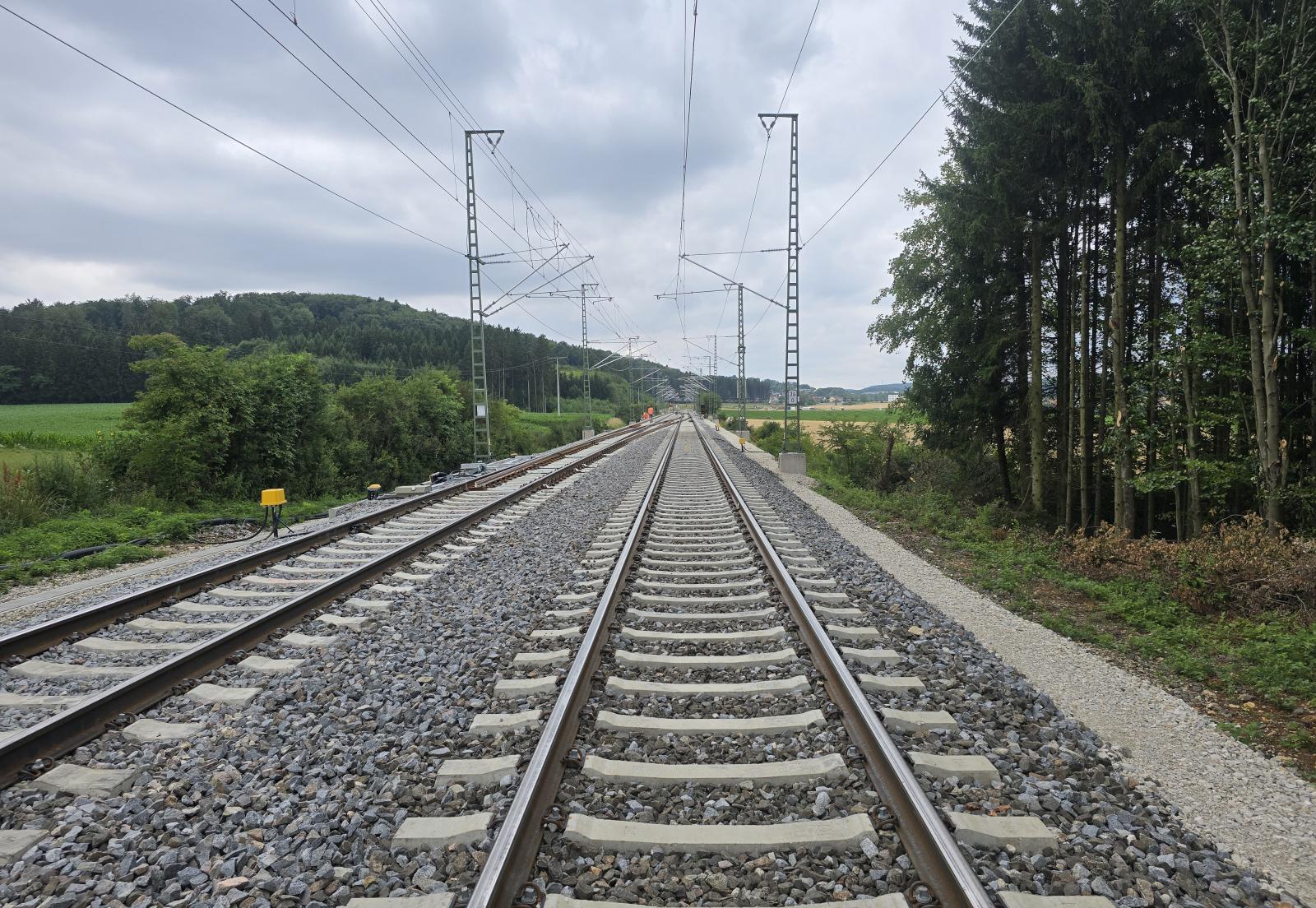
Passengers and freight operators are once again running on one of Bavaria’s most important rail routes following the full reopening of the Nuremberg-Regensburg railway line after an extensive programme of modernisation works.
From 1 August, normal passenger and freight services resumed across the corridor, which forms a key section of the European Rhine-Danube transport network and provides an important cross-border connection to Austria.
The route is also a central part of Deutsche Bahn’s long-term strategy to modernise more than 40 major rail corridors by 2036, with the aim of improving capacity, reliability and overall network performance across Germany.
As a key project partner, Hitachi Rail has played a significant role in upgrading the infrastructure and preparing the route for future digital railway technologies.
The modernisation programme has introduced new signalling and control systems designed to enhance operational reliability and improve performance for passengers and freight customers alike. The investment is expected to support better punctuality, more dependable connections and greater resilience across daily rail operations.
Among the works delivered by Hitachi Rail were the upgrade of eight existing electronic interlockings, the renewal of the axle counter system with an ETCS-ready solution, the migration of the control and operating system within the Munich control district, and a series of signalling-related modifications along the route.
“With the commissioning of these upgrades, the conditions are now in place to operate this section of the network in a more stable and flexible manner.”
“Our signalling and control technology plays a central role and also provides the foundation for future upgrades such as ETCS. A decisive factor in the project’s success was the close and collaborative partnership with DB InfraGO,” said Hannes Beck, Project Manager at Hitachi Rail.
The project marks one of the most significant recent railway modernisation schemes in Bavaria and demonstrates the growing importance of digital signalling in driving network performance improvements.
“The commissioning of the largest railway modernization project in Bavaria’s recent history demonstrates what can be achieved through close and trust-based cooperation. Together with Hitachi Rail and all other project partners, we successfully mastered the demanding challenges involved. I would like to thank everyone involved for this spirit of partnership,” said Lucas Griep, Project Manager for the Nuremberg-Regensburg Corridor Modernisation at DB InfraGO.
Hitachi Rail’s involvement in the region extends beyond the Nuremberg-Regensburg route. The company is also supporting the modernisation of the neighbouring Obertraubling-Passau corridor, where DB InfraGO began work in June 2026. Here too, Hitachi Rail is providing advanced signalling and control expertise to support the long-term transformation of a strategically important transport artery.
The successful completion of the Nuremberg-Regensburg project strengthens Germany’s drive towards a more reliable, digitally enabled railway. It also highlights the role of modern signalling technology in future-proofing legacy infrastructure and enabling the eventual introduction of the European Train Control System (ETCS).
As Germany continues its nationwide rail modernisation programme, projects such as this are expected to play a vital role in creating a higher-capacity, more efficient and more sustainable railway network, reinforcing rail transport’s position as the backbone of climate-friendly mobility and European economic connectivity.
Image credit: Hitachi Rail