Lessons learned from the Adamuz rail accident in Spain (2026)
Introduction
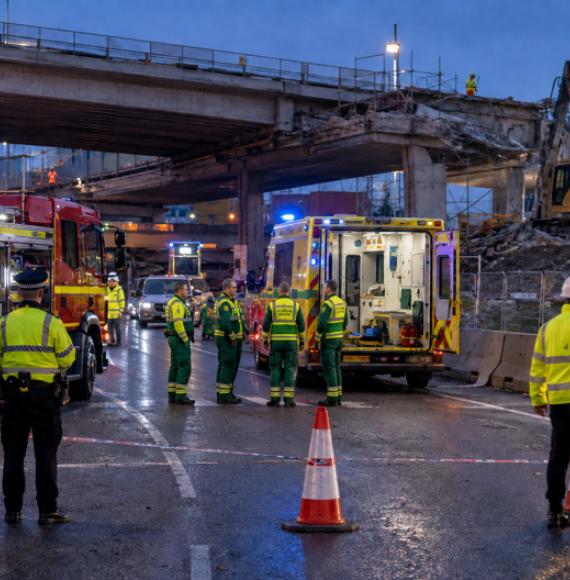
On 18 January 2026, a high-speed Iryo service derailed near Adamuz, Córdoba. The rear cars derailed, shifted over the adjacent track and were subsequently struck by an oncoming Renfe Alvia train. The accident resulted in 46 casualties and major disruptions on the Madrid–Andalusia corridor [1][2].
Initial findings indicate that the derailment was most probably triggered by a pre-existing infrastructure defect, most notably a rail fracture. Evidence from the investigation also suggests that this defect may have developed over time rather than occurring suddenly.
In addition, wheel damage patterns observed during the investigation indicate that early warning signs may already have been present on trains passing the location prior to the accident.
This highlights an important point: critical infrastructure issues may first become visible through the dynamic interaction between train and track—not only through direct infrastructure inspection.
This raises a fundamental question: could earlier detection of such signs have enabled intervention before failure occurred?
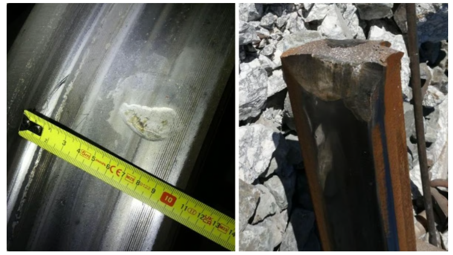
This paper explores how continuous extended fleet-based onboard monitoring can address this challenge. By using operational trains as sensing platforms and combining track-response data with additional onboard indicators, it is possible to detect, confirm, and escalate emerging defects earlier in the failure process, increasing the opportunity to prevent major incidents from happening later on.
The objective is not to replace existing inspection methods, but to complement them, reducing the time between defect emergence and actionable awareness and thereby improving overall railway safety.
From Periodic Inspection to Continuous Monitoring
Conventional railway infrastructure monitoring relies on a combination of visual inspection, scheduled maintenance and dedicated measurement assets, such as track-recording vehicles. These methods are essential and will remain a core part of railway safety.
However, their main limitation is not measurement quality but inspection periodicity. In practice, inspection intervals can range from days to weeks depending on network criticality and operational priorities. This creates a structural exposure: localized defects, such as rail fractures, deteriorating joints or support issues, can initiate and evolve over multiple train passages without being observed.
In failure scenarios such as Adamuz, this gap between defect emergence and detection becomes critical.
Continuous monitoring using operational trains directly addresses this limitation.
By using trains already in service as sensing platforms, infrastructure conditions become continuously observed parameters rather than periodic snapshots. The same route can be monitored far more frequently, without requiring additional track access or dedicated inspection runs.
This significantly increases the probability of detecting emerging defects at an earlier stage and under real operating conditions.
At the same time, continuous monitoring introduces a new challenge: interpretation of measurements. Vehicle response varies with operating conditions such as speed and track environment.
Rather than relying on all train control parameters, COSAMIRA®, an onboard edge platform developed by the Belgian company Televic, measures bogie dynamics directly to capture the physical interaction between wheel and rail.
With real-time onboard processing, the system enables detection and qualification of abnormal behaviour. However, detecting an abnormal signal alone is not sufficient; it must be interpreted in context to become a reliable and actionable warning.
The key requirement is therefore not only continuous measurement, but qualified detection, the ability to distinguish between transient events and infrastructure-related conditions.
COSAMIRA Case Study
To provide operational evidence, the following results illustrate how on-board monitoring can detect and characterize infrastructure defects under real operating conditions.
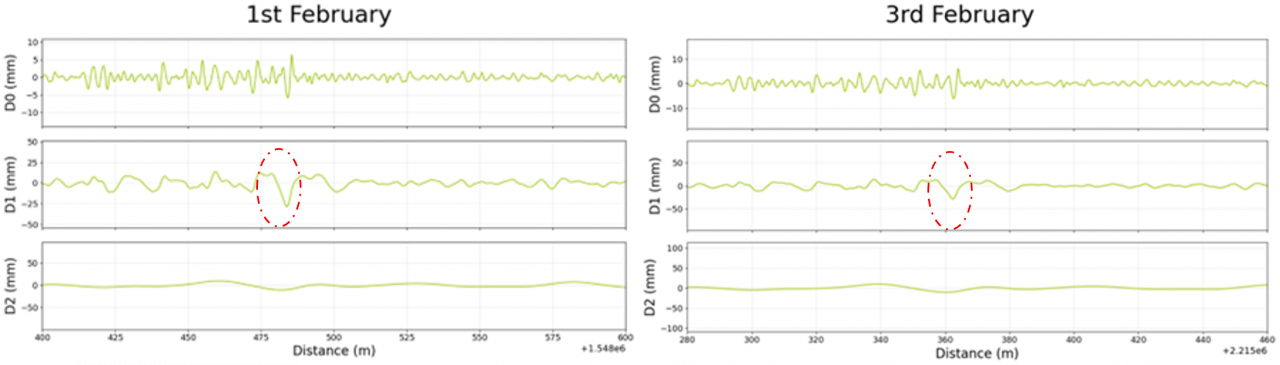
The results presented stem from a COSAMIRA® Edge unit operating in regular service conditions on an intercity corridor in South Asia, covering 26 route sections over approximately 1400 km in commercial passenger service. Processing is performed directly onboard in real time and produces geo-referenced longitudinal-level indicators in the D0, D1 and D2 wavelength bands (short, medium, and long geometry irregularities as defined in EN 13848) [3].
This ensures that the output is directly comparable with established infrastructure quality standards.
Key observations
- Stable baseline with localized anomalies
Most of the route remains within a stable range, with a limited number of clear hotspots, primarily in the D2 band, indicating infrastructure-related effects rather than train-induced responses.
- Repeatability across runs
The same geo-localized signatures reappear consistently across multiple runs, confirming that detected anomalies are not transient artefacts.
- Sensitivity to local defects
Distinct peaks are observed at specific locations and across multiple wavelength bands, characteristic of localized infrastructure issues.
- Trend detection
Changes in amplitude and signal shape over time enable identification of evolving defects.
How continuous monitoring applies to the Adamuz failure pattern
If the Adamuz failure sequence is confirmed broadly along current findings, it suggests that the infrastructure defect developed progressively rather than instantaneously.
In such cases, early warning signals are typically present before failure, even if they are not yet formally identified. As trains pass over the affected location, they may generate abnormal but repeatable responses such as localized track-response peaks or emerging wheel-impact indicators.
With conventional inspection methods, these early signals may remain unnoticed or uncorrelated between inspection intervals.
Continuous onboard monitoring changes the situation fundamentally: as multiple trains pass the same location, abnormal responses can be detected repeatedly within a short time frame. What initially appears as an isolated anomaly becomes a consistent, geo-localized pattern.
At the same time, additional indicators, such as wheel-condition or wheel-impact measurements, may begin to show anomalies on those trains. Combining these signals provides independent confirmation of a developing issue.
The combination of recurrence, location consistency, and multi-indicator correlation increases confidence in the findings, creating a window for action. In practice, this means more time to act before a defect leads to failure.
Operators can then respond, for example by applying speed restrictions, triggering targeted inspections, or temporarily isolating the affected track section.
No single technology can guarantee the prevention of a specific accident. However, earlier detection increases the range of available preventive actions and significantly reduces risk exposure.
To learn more about COSAMIRA® or to discuss a pilot deployment, please contact us at [email protected]
References
[1] Leonardo Benassatto and Susana Vera, “Two high-speed trains collide in Spain, 21 killed.” Reuters, 18 Jan. 2026. Available: https://www.reuters.com/world/europe/two-high-speed-trains-derail-spain-police-said-2026-01-18
[2] “Rail fracture likely occurred before train crash in southern Spain, investigators say.” Reuters, 23 Jan. 2026. Available: https://www.reuters.com/world/europe/rail-fracture-likely-occurred-before-train-crash-southern-spain-investigators-2026-01-23
[3] EN 13848-1:2019, “Railway applications — Track — Track geometry quality — Part 1: Characterization of track geometry.”
[4] Comisión de Investigación de Accidentes Ferroviarios (CIAF), Nota de la CIAF sobre la investigación del accidente de Adamuz: actualización de información disponible en las primeras horas tras el suceso [CIAF note on the investigation of the Adamuz accident: update on information available in the first hours after the event] (Madrid: Ministerio de Transportes y Movilidad Sostenible, 23 January 2026), fig. 1, p. 2, https://www.transportes.gob.es/recursos_mfom/actualizacion_nota_adamuz.pdf.
Hero Image credit: iStock