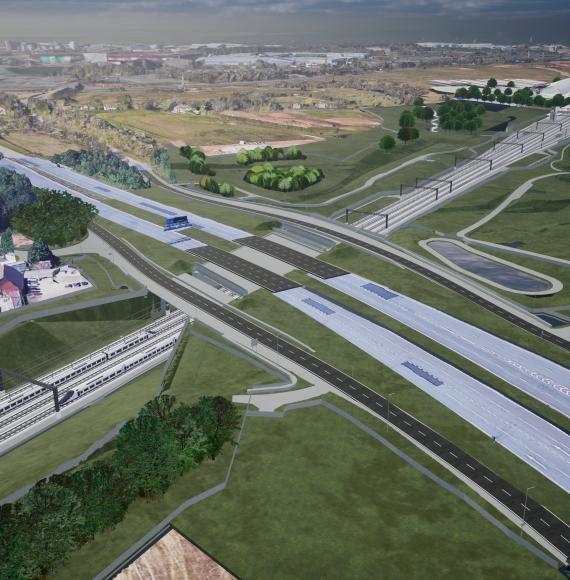

Poland is pressing ahead with plans to transform its national rail network through a programme of new high-speed railway lines designed for trains operating at up to 350 km/h.
The first route, known as the Y Line, is already progressing under the Port Polska programme and will form the backbone of a wider high-speed network linking the country's largest cities, strengthening regional connectivity and improving international rail links across Central and Eastern Europe.
The Warsaw-Łódź section of the line is scheduled to open in 2032, with extensions to Poznań and Wrocław expected to follow by 2035.
A new chapter for Polish rail
Poland's rail sector has already made significant progress in increasing operating speeds. Trains currently run at up to 200 km/h between Warsaw and Gdańsk, while services on the southern section of the Central Railway Main Line (CMK) are expected to reach 250 km/h from 2027.
The next phase of development will see the construction of dedicated high-speed corridors designed for speeds of up to 350 km/h.
Although infrastructure will be built to accommodate those speeds, actual commercial operations are likely to vary depending on rolling stock performance, operational requirements, energy consumption and economic considerations.
Across Europe, many railways designed for 350 km/h operation typically run passenger services at around 300-320 km/h to balance journey times with operating costs.
Planners say the new infrastructure is being developed with a long-term perspective, ensuring it can accommodate future generations of rolling stock, technological advances and lower-cost low-carbon energy sources.
Y Line to be first high-speed route
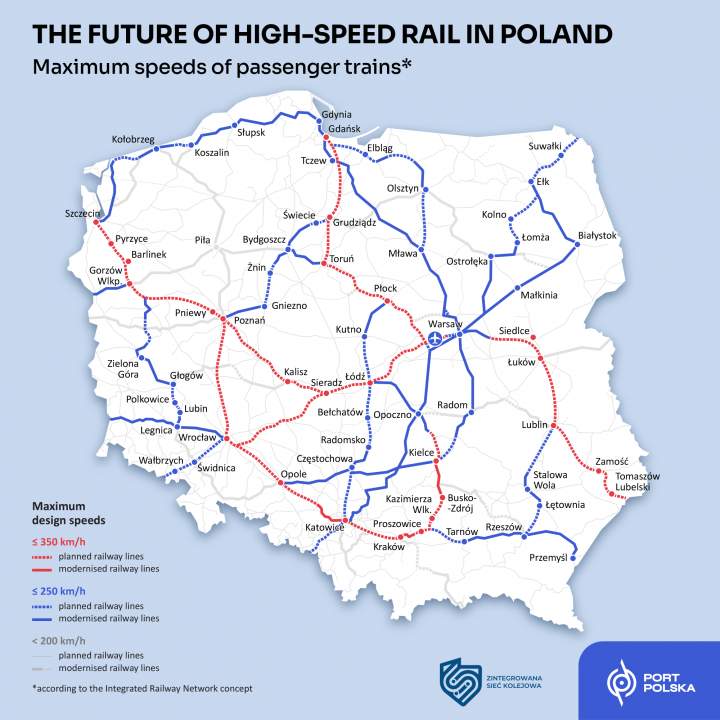
The flagship Y Line will connect Warsaw with the new airport and Łódź before splitting towards Poznań and Wrocław via Sieradz and Kalisz.
Plans also include extending the Poznań branch towards Szczecin via Gorzów Wielkopolski, with a future connection to Berlin under consideration.
If completed, the route would provide a new high-speed rail link between Warsaw and Berlin, offering an alternative to the existing corridor via Rzepin. Existing infrastructure on Railway Line 3 would continue serving passenger traffic while also supporting additional freight movements.
Additional 350 km/h corridors planned
Several other major corridors are being developed as part of Poland's Integrated Railway Network.
Northern Central Railway Main Line
A new high-speed route is proposed between Warsaw, the new airport and Gdańsk via Płock, the Toruń area and Grudziądz.
The line is being designed for speeds of up to 350 km/h and is expected to serve one of the country's busiest future passenger markets.
Southern Main Line
The Southern Main Line will link Wrocław, Opole, Katowice and Kraków, connecting key industrial and economic centres across southern Poland.
The Poznań-Wrocław section is also planned to support operating speeds of up to 350 km/h.
Eastern Main Line
A new eastern corridor would connect Warsaw with Siedlce, Lublin, Zamość and ultimately Lviv in Ukraine.
The project is intended to strengthen east-west connectivity while supporting future international passenger and freight links.
New Warsaw-Kraków route
Another planned high-speed line would branch from the Central Railway Main Line near Opoczno before continuing through Kielce and Busko-Zdrój to Kraków.
Design speeds are expected to exceed 300 km/h.
Further routes planned for 250 km/h operation
Alongside the flagship high-speed lines, the programme identifies several strategic corridors designed for speeds of up to 250 km/h.
These include:
- Lublin-Stalowa Wola-Rzeszów
- Kraków-Tarnów-Rzeszów-Przemyśl
- Warsaw-Białystok-Ełk-Suwałki
- Ostrołęka-Łomża-Ełk
The proposed Baltic-Czechia Main Line would connect the Tricity metropolitan area of Gdańsk, Gdynia and Sopot with Bydgoszcz, Żnin, Poznań and Wrocław before reaching the Czech border via Wałbrzych.
Other planned projects include the North-South Main Line linking Płock, Kutno, Łódź, Radomsko, Częstochowa and Katowice, as well as a western corridor between Wrocław, Legnica, Lubin, Głogów, Zielona Góra and Gorzów Wielkopolski.
Additional routes are planned from Warsaw to the Tricity area via Mława, from Gdańsk to Olsztyn via Elbląg, and along the Baltic coast through Słupsk and Koszalin to Szczecin.
Faster journeys and economic growth
Supporters of the programme argue the benefits extend beyond reduced journey times.
One example is the proposed Eastern Main Line, which is expected to cut travel times between Rzeszów and Warsaw from around five hours to approximately two hours.
Improved connectivity is expected to support access to employment, education and business opportunities, while strengthening economic links between regions and major urban centres.
Investment decisions are being informed by passenger and freight demand modelling, helping planners identify routes that offer the strongest social and economic returns.
Long-term vision for Poland's railways
The Integrated Railway Network forms part of a long-term strategy to determine the rail infrastructure Poland will require over the coming decades.
Commissioned by the Ministry of Infrastructure on behalf of the Government Plenipotentiary for the Central Transport Hub, the analysis was undertaken by experts from Port Polska's Centre for Transport and Mobility in collaboration with PKP Polish Railway Lines (PKP PLK) and the Institute of Urban and Regional Development.
Announced in June 2026, the programme sets out long-term priorities for rail investment while considering regional transport demand, economic development objectives and national resilience requirements.
The overarching goal is to make rail a more attractive and accessible alternative to road and air travel, while supporting sustainable economic growth across Poland.
Image credits: iStock and Port Polska