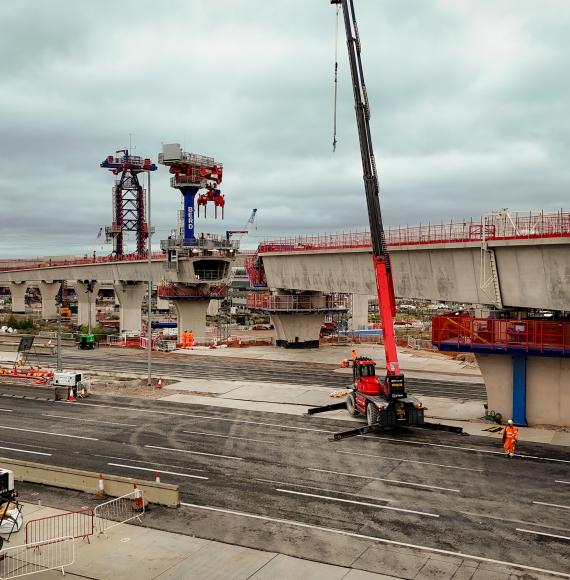
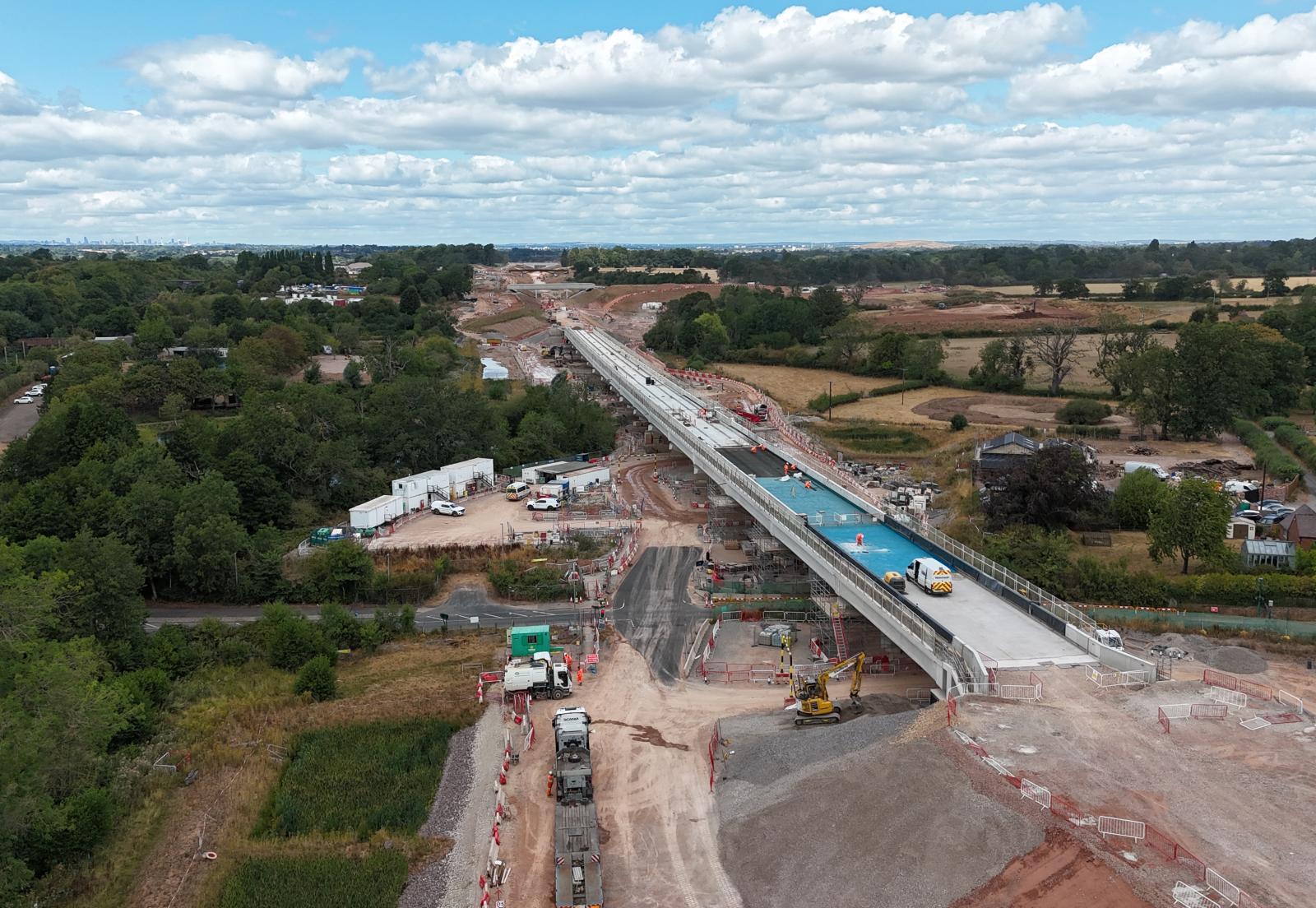

HS2 has achieved another significant construction milestone in the West Midlands with the structural completion of three major viaducts on the southern approach to Interchange Station in Solihull.
The trio of structures, Balsall Common Viaduct, Marsh Farm Viaduct and River Blythe Viaduct, form a critical section of the route leading to the new station, which will provide high-speed connections between London, Birmingham and destinations across the North West and Scotland.
Constructed by HS2’s delivery partner Balfour Beatty VINCI, the three viaducts showcase the scale of engineering involved in delivering Britain’s largest infrastructure project while also highlighting extensive efforts to minimise environmental impact and respond to community feedback.
In the coming days, engineers will install the final parapets on the River Blythe Viaduct, the largest of the three structures and the closest to Interchange Station, located approximately 1.5 miles away.
The neighbouring Marsh Farm Viaduct became the first of the three to reach completion during summer 2025, while the main structure of the Balsall Common Viaduct was finalised earlier this year. Installation of all 304 parapets on Balsall Common Viaduct is expected to be completed by spring 2027.
Doug Barnett, HS2 Ltd’s senior project manager said:
"Our engineering teams are making fantastic progress on the Interchange Station approach, and it’s a significant achievement that all three viaducts in the Solihull borough are now structurally complete.
"The design and landscaping solutions were of upmost importance to local residents, and we worked extremely hard to get that right."
River Blythe Viaduct
The 495-metre-long River Blythe Viaduct has been carefully designed to cross the River Blythe, its floodplain and Meriden Road near Hampton in Arden while respecting the sensitive environmental setting.
As both the River Blythe Viaduct and Balsall Common Viaduct were designated Key Design Elements (KDEs), local communities were given an opportunity to influence elements of their design.
The River Blythe is a designated Site of Special Scientific Interest (SSSI), leading engineers to adopt a low-profile design. Rising just 12 metres above ground level, the structure is supported by two abutments and 19 concrete piers featuring distinctive Y-shaped splits, reducing concrete usage while improving visual appearance.
Community consultation also influenced the choice of larger polished parapets and landscaping arrangements, including tree planting to help integrate the structure into the surrounding environment.
Wildlife considerations have been central to the design, with space beneath the viaduct creating safe movement corridors for species including badgers, bats, birds, fish, great crested newts, otters and water voles.
With the structure now complete, teams will focus on final waterproofing works and the installation of acoustic barriers.
Marsh Farm Viaduct
Located around two-and-a-half miles south of River Blythe Viaduct, the 145-metre-long Marsh Farm Viaduct is the smallest of the three structures.
The viaduct carries the HS2 main line across Bayleys Brook and surrounding marshland. Standing only five metres above ground level, it is currently being used as a temporary haul road, supporting construction of nearby embankments and cuttings while helping reduce the number of heavy goods vehicles on local roads.
Balsall Common Viaduct
The 430-metre-long Balsall Common Viaduct sits on the north-eastern edge of Balsall Common village and crosses Station Road, Truggist Lane, Bayleys Brook, the Heart of England Way and surrounding floodplain areas.
With structural works now complete, attention is turning to the installation of parapets selected through a public consultation process.
Residents voted for a polished finish designed to reflect the surrounding landscape and sky, while a distinctive woven pattern was chosen to celebrate the area's textile heritage.
Matthew Parkes, Construction Manager at Balfour Beatty VINCI said:
"The structural completion of these viaducts is a huge another achievement for Balfour Beatty VINCI and its supply chain partners. All three viaducts span a range of diverse landscapes and environments, including wetlands, foodplains, SSSIs and water courses – making this achievement even more remarkable.
"Every effort has been made to protect these precious spaces and habitats. The realignment of Bayleys Brook is just one example of how the team has delivered on this commitment, where engineers carefully diverted a 150-metre section of the brook to allow Balsall Common Viaduct to pass over the top."
Key Step Towards Britain’s New Railway
HS2's network will ultimately include more than 500 bridges and other structures, including over 50 major viaducts spanning a combined length of approximately 15 kilometres.
Once operational, the railway is expected to deliver faster and more reliable long-distance journeys while creating additional capacity on the heavily congested southern section of the West Coast Main Line.
From Interchange Station, passengers will be able to travel north towards Manchester, Liverpool and Scotland, or south to London Euston and Old Oak Common, which will provide direct connections to more than 100 destinations across the UK.
Image and video credits: HS2