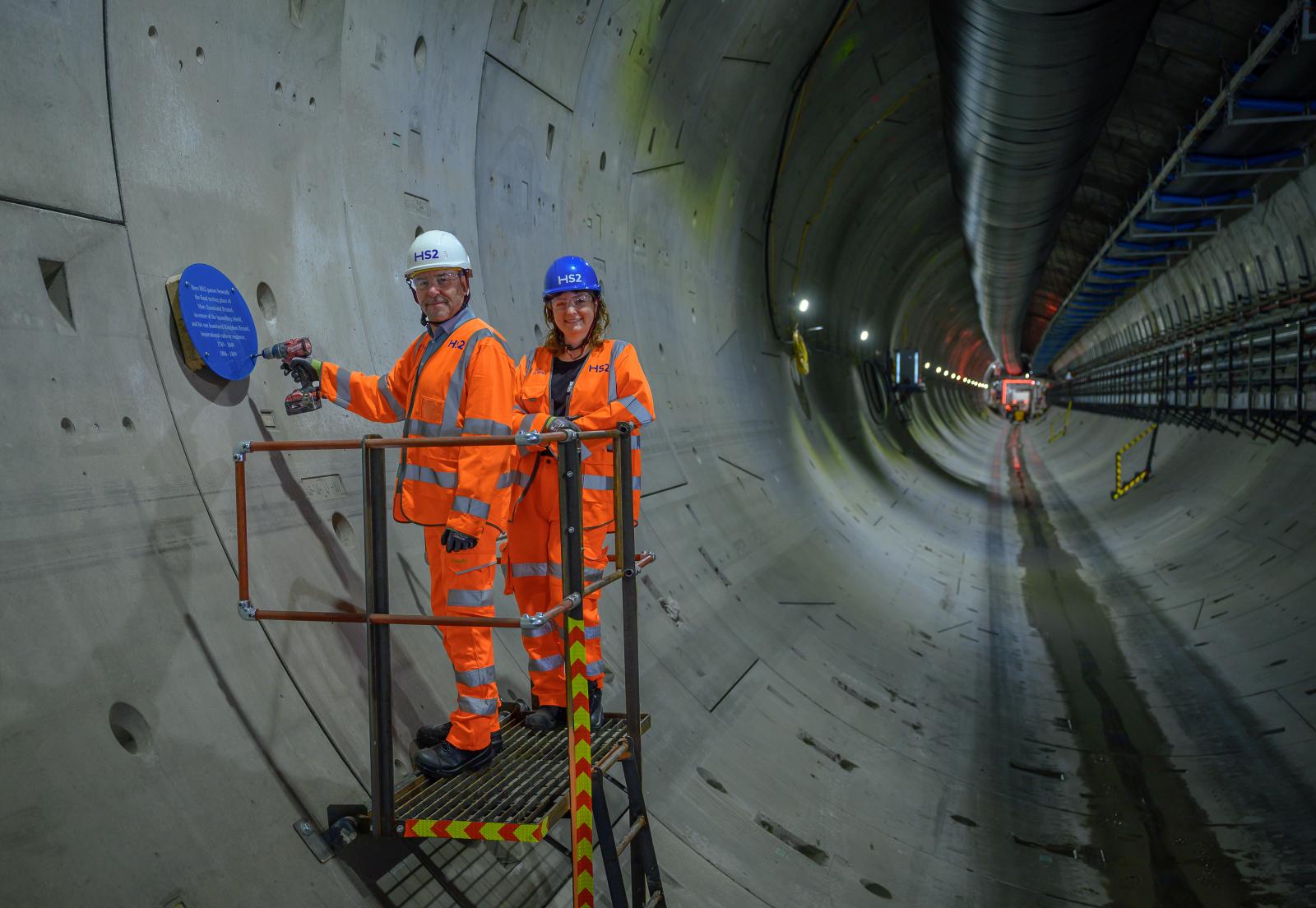

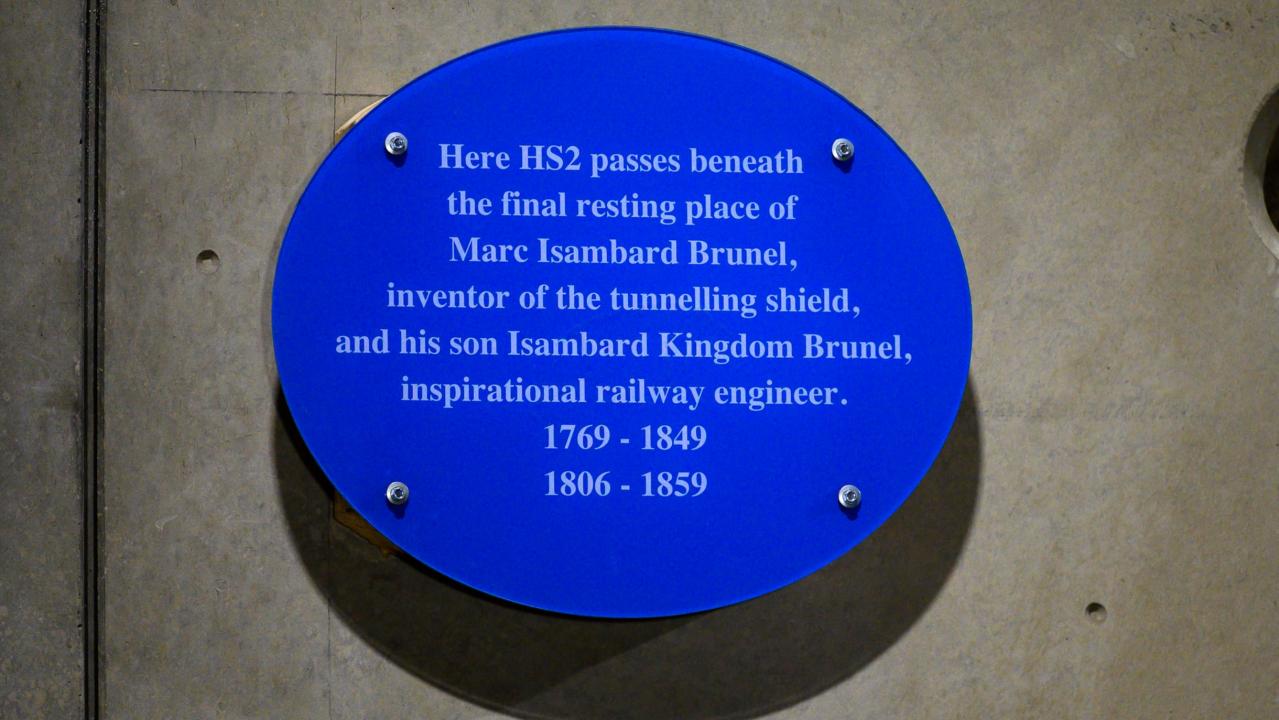
A new commemorative plaque has been installed 40 metres below ground on the HS2 Euston Tunnel, marking the point where Britain's new high-speed railway passes beneath the final resting place of one of the world's most influential engineering families.
The plaque, unveiled by HS2 Ltd Chief Executive Mark Wild, recognises the extraordinary contributions of Sir Marc Isambard Brunel and his son, Isambard Kingdom Brunel, whose pioneering achievements continue to shape modern rail and tunnelling engineering.
Located beneath Kensal Green Cemetery, one of London's historic "Magnificent Seven" cemeteries, the marker sits within the Euston Tunnel currently being constructed between Old Oak Common and central London by the Skanska Costain STRABAG (SCS) joint venture.
The two tunnel boring machines (TBMs) driving the 4.5-mile tunnel towards Euston are following a path that carries remarkable historical significance. Beneath the cemetery lie the tombs of Sir Marc Brunel, the inventor of the tunnelling shield, and his son Isambard Kingdom Brunel, widely regarded as one of Britain's greatest civil engineers.
Sir Marc Brunel revolutionised underground construction when he patented the tunnelling shield in 1818, drawing inspiration from the shipworm's ability to bore through timber. His invention enabled the construction of the Thames Tunnel, completed in 1843 and celebrated as the world's first tunnel beneath a navigable river.
More than two centuries later, the principles behind Brunel's innovation remain central to modern tunnelling. Today's giant TBMs used on HS2 continue to rely on shield technology descended from Sir Marc's groundbreaking design.
His son, Isambard Kingdom Brunel, transformed Britain's railway landscape through landmark projects including the Great Western Railway, Paddington Station, the Clifton Suspension Bridge and the Box Tunnel between Chippenham and Bath. When completed, Box Tunnel was the longest railway tunnel in the world and remains one of Brunel's most celebrated engineering achievements.
As tunnelling progresses across the HS2 route, extensive surveying and monitoring programmes are being undertaken to protect sensitive heritage sites. At Kensal Green Cemetery, specialist assessments and engineering controls have ensured the works are delivered safely and respectfully while safeguarding historic assets.
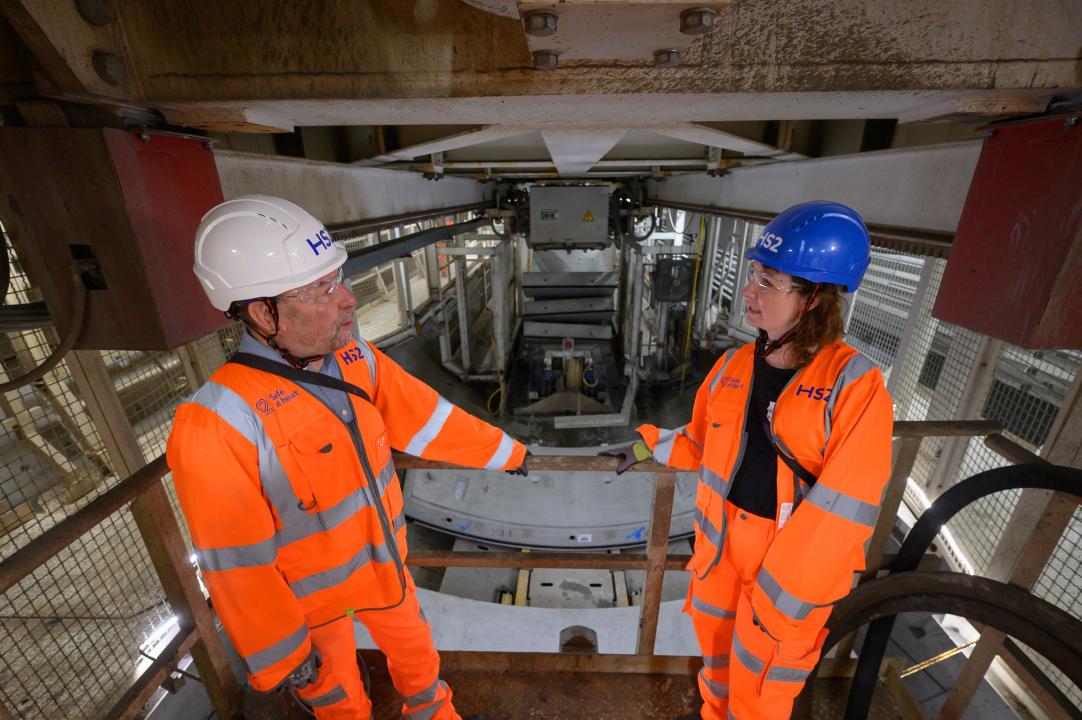
Mark Wild, Fellow of the Royal Academy of Engineering and HS2 Ltd CEO, said:
“The significance of the achievements of both Sir Marc and Isambard Brunel in engineering cannot be under played. How we build our tunnels today is because of Sir Marc’s work, and how we build our railways is because of how Isambard Brunel built the Great Western Mainline. He built railways flat and straight, and future-proofed them for improvements in speed and capacity which is why we still use them today.
“Installing this plaque gives me the opportunity to reflect on the scale of what the 30,000 strong workforce on HS2 are building – a new railway for future generations that will stand the test of time, despite all the challenges we face.”
Katherine McAlpine, Director of the Brunel Museum, said:
“Modern tunnelling of the scale of HS2 would not have been possible without Marc Brunel. His tunnelling shield which he patented in 1818, made way for the Tunnel Boring Machines of today. 200 years ago, the father and son team embarked on an audacious project to dig the world’s first tunnel under a navigable river, laying the foundations for huge projects like this.
“I am delighted we are able to mark this milestone of HS2 travelling underneath the final resting place of Marc Brunel and Isambard Kingdom Brunel, as a testament to their ingenuity and perseverance.”
Eddie Edmonds, Delivery Lead, Skanska Costain STRABAG joint venture, said:
“It’s a privilege to be able to recognise Sir Marc and Isambard Brunel as we pass beneath their memorial. They paved the way for safe modern tunnelling methods and the use of shielded tunnel machines that have enabled us to be safely tunnelling today.
“For the SCS team delivering the tunnel, passing beneath Brunel's final resting place is both a technical achievement and a moment of reflection. Unveiling this plaque recognises the extraordinary engineering legacy Brunel left behind while celebrating the expertise and commitment of our workforce today and the way we're delivering the works that will shape the country's infrastructure for generations to come.”
The Euston Tunnel TBMs began excavation in early 2026 following the Government's commitment to extend HS2 into central London. The tunnels are expected to be completed next year, with the machines breaking through close to the site of the future HS2 Euston station.
The railway is designed to improve connectivity between London, Birmingham and the North while creating additional capacity on the heavily congested southern section of the West Coast Main Line. Meanwhile, HS2's leadership team is continuing a programme-wide reset aimed at delivering the remaining 140-mile route between London and Birmingham as efficiently as possible and at the lowest reasonable cost.
Image and video: HS2