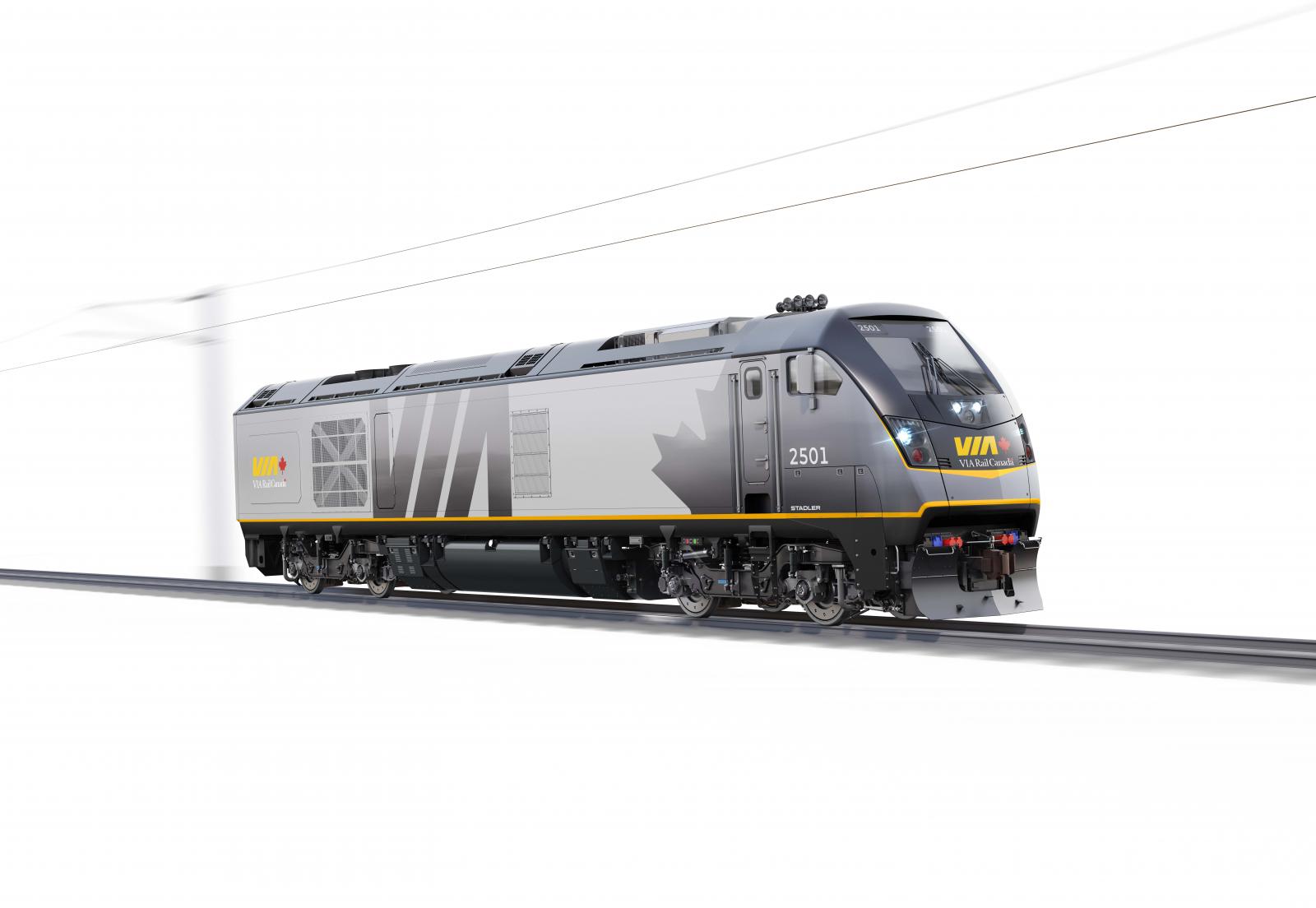

Swiss rolling stock manufacturer Stadler has secured its first locomotive contract in Canada after signing an agreement with VIA Rail Canada to supply 45 hybrid battery-diesel locomotives for the country's Long-Distance, Regional and Remote Rail (LDRR) programme. The deal also includes a 20-year Technical Support and Spare Supply Agreement (TSSSA), reinforcing Stadler's long-term commitment to the Canadian passenger rail market.
The new locomotive fleet forms a key part of VIA Rail's strategy to modernise services, improve reliability across its national network and accelerate rail decarbonisation. Designed specifically for Canada's challenging operating environment, the locomotives will be capable of operating in temperatures as low as -50°C while delivering enhanced performance, reduced emissions and lower lifecycle costs.
Hybrid Technology to Drive Efficiency and Sustainability
At the heart of the new fleet is an advanced hybrid architecture that combines proven diesel-electric traction with battery-assisted technology. The locomotives will feature onboard battery modules capable of supplying power for auxiliary systems, head-end power and traction requirements.
By integrating battery power with the diesel engine, the locomotives will deliver up to 4MW of power at the wheel, generate a starting tractive effort of 350kN and reach speeds of up to 160km/h (100mph). This combination is expected to provide strong acceleration, improved performance on gradients and reliable operation across Canada's extensive passenger rail network.
The battery system will also recover and store braking energy, improving energy efficiency while reducing fuel consumption and maintenance demands. Battery-assisted operation will allow the locomotives to operate with significantly lower greenhouse gas emissions, supporting VIA Rail's wider environmental objectives.
In urban stations and environmentally sensitive areas, the locomotives will be able to operate in battery-only mode, cutting both noise and exhaust emissions. The battery system also provides an additional layer of operational resilience by enabling trains to continue to a safe location should a diesel powertrain failure occur.
Stadler says sustainability has been embedded into the vehicle design, with recyclability rates exceeding 92% and recoverability rates above 95%. The batteries have also been designed with long service life and second-life applications in mind.
Engineered for Canada's Harsh Climate
The locomotive platform draws on Stadler's experience of operating vehicles in demanding Nordic environments, including Sweden and Norway, where similar technologies have proven their reliability over more than a decade.
The fleet will be used on services linking major cities with remote communities across Canada, supporting VIA Rail's objective of providing reliable, accessible and environmentally sustainable passenger transport nationwide.
Iñigo Parra, Executive Vice-President Division Spain, said:
"Our hybrid locomotive platform combines performance, reliability and sustainability.”
“By integrating battery-assisted operation into a powerful long-distance locomotive, we are providing VIA Rail with a future-oriented solution that supports its environmental objectives while enhancing operational flexibility and passenger service."
Manufacturing and Support Programme
The locomotives will be designed, manufactured and delivered by Stadler Valencia, the company's centre of excellence for locomotive development in Spain. The Albuixech facility, located near Valencia, employs more than 500 engineers focused on rail vehicle design and innovation.
While Stadler will retain overall project responsibility, elements of assembly, testing and commissioning will be undertaken in Canada, helping to strengthen local rail industry capability.
As part of the agreement, Stadler's Service Division will provide long-term fleet support through a new Canadian subsidiary. Maintenance personnel will be based at VIA Rail facilities in Montreal, Toronto, Winnipeg and Vancouver under the 20-year TSSSA framework.
The programme is expected to support skilled employment across manufacturing, testing and maintenance while facilitating the transfer of advanced rail technology expertise into Canada. The wider investment has been valued at approximately C$1.95 billion and is expected to support around 1,200 jobs across the Canadian rail sector.
Image credit: Stadler