
The UK rail industry has taken a decisive step towards modernising operational communications, with RSSB’s Industry Leadership Group (ILG) agreeing to phase out signal post telephones (SPTs) from future re‑signalling projects.
The decision follows a request from Network Rail to stop the routine provision of signal post telephones during re‑signalling works, beginning with its Fife re‑signalling project. After reviewing the evidence, the ILG concluded that SPTs no longer provide a proportionate or effective safety benefit when compared with modern alternatives.
Evidence shows limited safety benefit and high ongoing cost
RSSB analysis found that most signal post telephones are rarely used, offer a poor safety profile as secondary communication provision, and represent a significant ongoing cost to the industry.
More effective alternatives are already available, including:
- Portable communication devices issued directly to drivers
- Dual‑SIM capability, allowing on‑board GSM‑R radios to roam onto alternative mobile networks when required
These approaches provide more reliable secondary communications without requiring drivers to leave the cab and access the trackside environment.
£22.5m annual maintenance burden removed
The move is expected to deliver substantial cost savings by avoiding the future installation and long‑term maintenance of fixed lineside telephones.
Network Rail currently maintains around 32,000 signal post telephones across the Great Britain rail network, at an estimated cost of £22.5 million per year. Major re‑signalling schemes add further expense through design work, cabling, power supplies and associated infrastructure.
By removing the requirement for new installations, the industry can reduce unnecessary assets, simplify designs and limit the need for staff access to the track.
Industry leaders welcome clarity and leadership
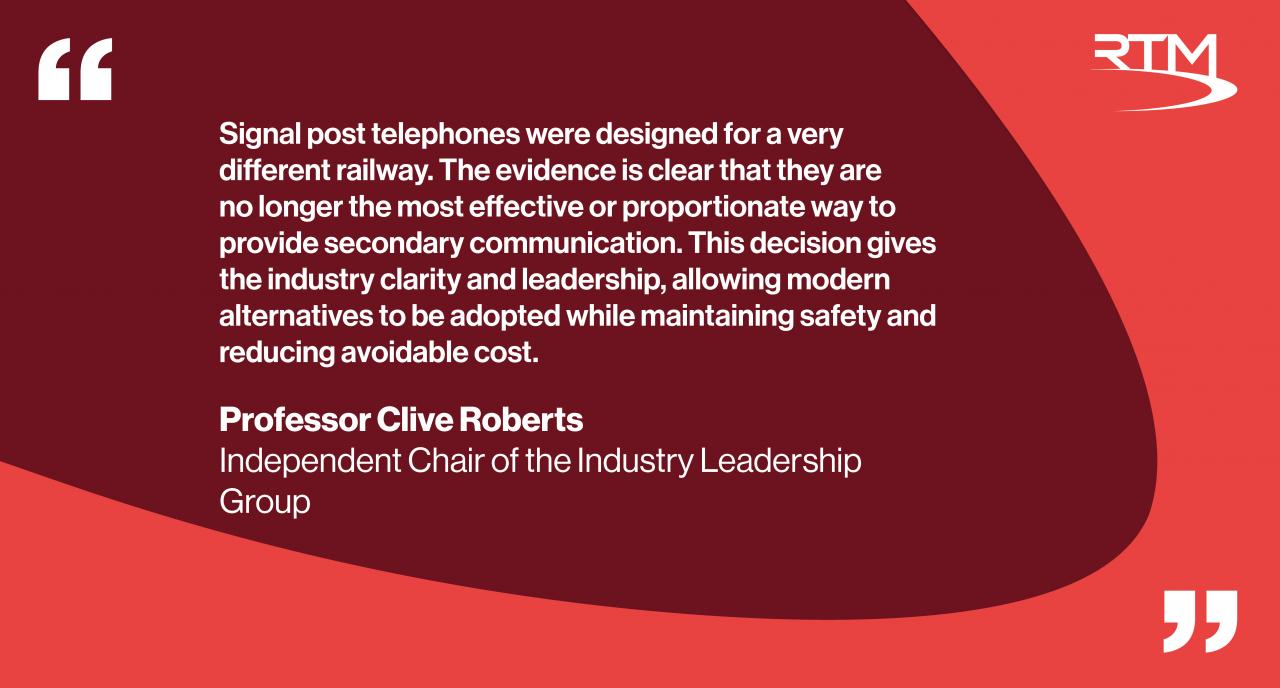
Professor Clive Roberts, Independent Chair of the Industry Leadership Group, said:
Tom Lee, RSSB Director of Standards, said:
‘This decision demonstrates how RSSB supports the rail industry to move away from outdated legacy solutions and towards safer, more cost-effective risk-based outcomes. By focusing on what genuinely supports safety and operational effectiveness today, we can remove barriers to adopting changes in technology and operating practices, eliminating unnecessary cost and creating space for better, more flexible solutions to be adopted.’
Martin Frobisher, Network Rail’s Group Safety and Engineering Director, said:
‘The Industry Leadership group is making a real difference. It is enabling us to take decisions in the interests of the whole industry. The recent decision about signal post telephones improves safety and saves money. In this age of modern mobile telecommunications, it makes no sense whatsoever for a train driver to climb down from the cab and to use an old-fashioned telephone phone handset in a box on the railway lineside.’
Supporting a safer, more efficient railway
By approving the change, the Industry Leadership Group aims to support more proportionate investment, reduce unnecessary infrastructure and maintenance costs, and improve workforce safety by limiting exposure to trackside hazards.
The decision provides long‑term clarity for re‑signalling programmes across Great Britain and reinforces the industry’s shift towards risk‑based, technology‑enabled solutions that better reflect the needs of today’s railway.
Image credit: iStock